
AI Murder Mystery

Investing world’s own version of Murder Mystery
Markets have taken on an unusually unsettled tone in recent weeks. What was once framed as a promise of a better, AI-powered world for everyone is now forcing investors into a far more humbling reckoning. Instead of clarity, there’s confusion. Instead of celebration, there’s suspicion. The investment world is living through its own kind of murder mystery – we all know the disruptive force at work, but we’re still trying to figure out which business models will and won’t survive it.
This is not because AI is fake or that the technology isn’t real, but because the market is trying to price a story where the ending is obvious, while the victims are not. We all know the “murderer,” right? The disruptive force is clear: AI – a capital-intensive, infrastructure-heavy technology evolving faster than businesses can adapt, policymakers can regulate, and markets can fully comprehend.
But the part that’s messing with people (and absolutely showing up in price action) is: who gets murdered? Which business models gets quietly strangled by automation? Which margin structures collapse? Which companies wake up one day and realize their moat was in fact only a shallow stream.
And then there’s the extra twist: we don’t even know who isn’t on the playboard yet. In other words, the biggest winners or the scariest threats might still be private, still emerging, still hiding behind a press release and a funding round.
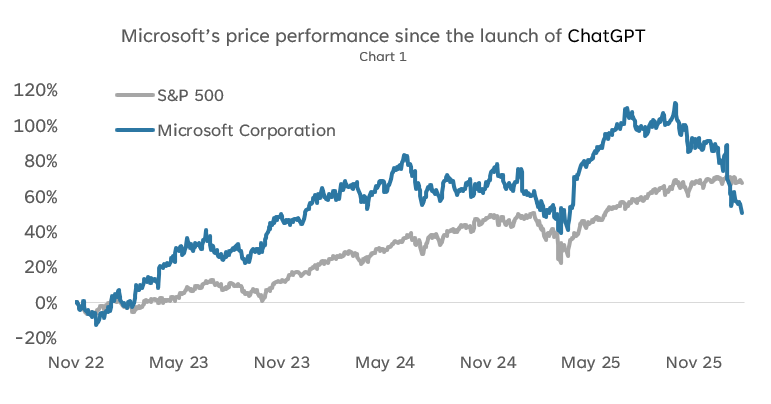
So, you get this strange market behaviour where:
- The index can be near a high, but a multitude of stocks are getting annihilated.
- Entire software cohorts sell off together, almost indiscriminately.
- And investors start acting like the terminal value of whole categories has changed, even if the day-to-day product reality hasn’t caught up yet.
The irrationality isn’t the worry – it’s the timing and the rate of change
Is it irrational to think this AI trade could be a bubble, or is there an even more uncomfortable possibility we should consider? If it is a bubble, what if it isn’t a traditional one? The buildout could be real and transformative yet still leave casualties in its wake.
Think of the late 90s telecom and fibre buildouts. That era wasn’t “wrong” in the big picture. Laying fibre did modernize the economy. But the returns didn’t go evenly to everyone who spent the money, and a lot of companies got flattened on the way there.
AI can be the internet-level infrastructure shift and still cause a brutal, messy repricing in the middle. So, when people say, “the market is being irrational,” We think the better framing is: “the market might be rational about the direction, but chaotic about the mapping”.
Direction: AI changes margins, labour, pricing power, and defensibility.
Mapping: who wins, who loses, and how fast it happens.
And speed matters. Society can absorb job change when it happens slowly, but when the rate of change accelerates, you get fear, politics, and a kind of ambient anxiety that leaks into everything including hiring, spending, elections, even how people talk at dinner parties. That part felt very real: it was fine when disruption hit blue-collar workers; a “white-collar recession” is a different emotional experience.
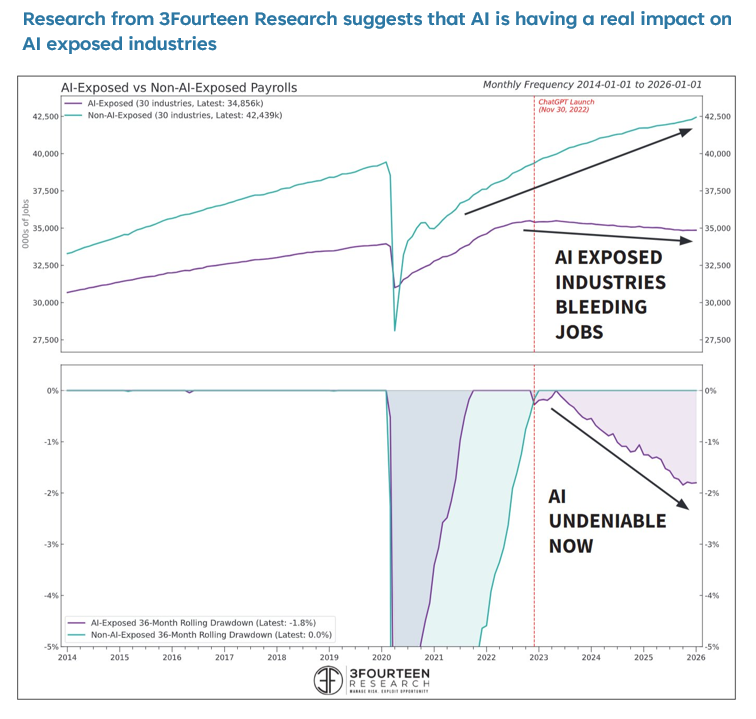
Why “murder mystery” is the perfect metaphor
A normal market cycle gives you a clean narrative wherein new tech emerges; a few leaders benefit and adoption spreads. In hindsight the winners are clear and obvious.
This cycle feels different because the market is pricing the ending before the plot is written.
We’re doing the reveal first:
- AI will transform work.
- AI will compress some margins and expand others.
- AI will change how software gets built, sold, and used.
These are all great plots, but who dies?
And because nobody can confidently answer that yet, you get broad sell-offs, second-guessing, and the strangest part of all: investors are selling companies with strong moats and fundamentals without any proof of deteriorating fundamentals.
That’s what happens when the crowd shifts from excitement to scrutiny. The most practical takeaway: This is an era of out-of-sample reality checks
We have history. We have backtests. We have analogies. We do not have a clean forward dataset for this. So, investors are left doing what humans always do under uncertainty:
- Overreact to headlines,
- Cluster into simple narratives,
- and sell anything that looks remotely exposed.
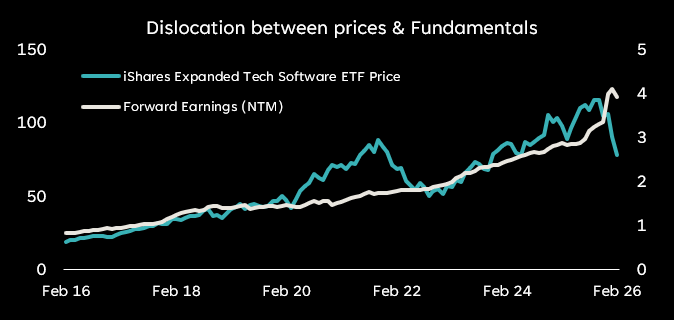
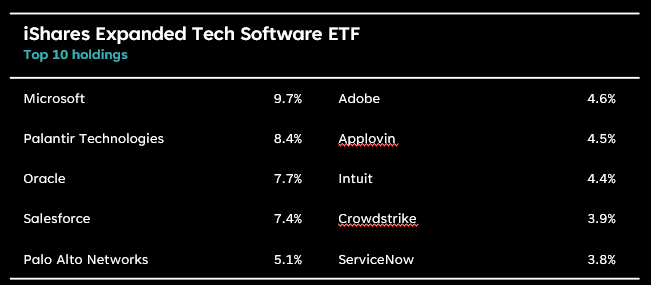
There may be no clearer example right now than the indiscriminate selling pressure across blue chip software names (see below), where each new headline about Anthropic’s Claude sends investors racing for the exits, pricing in disruption everywhere from cybersecurity to payments, whether the fundamentals justify it or not
So, who is Citrini and why does it matter?
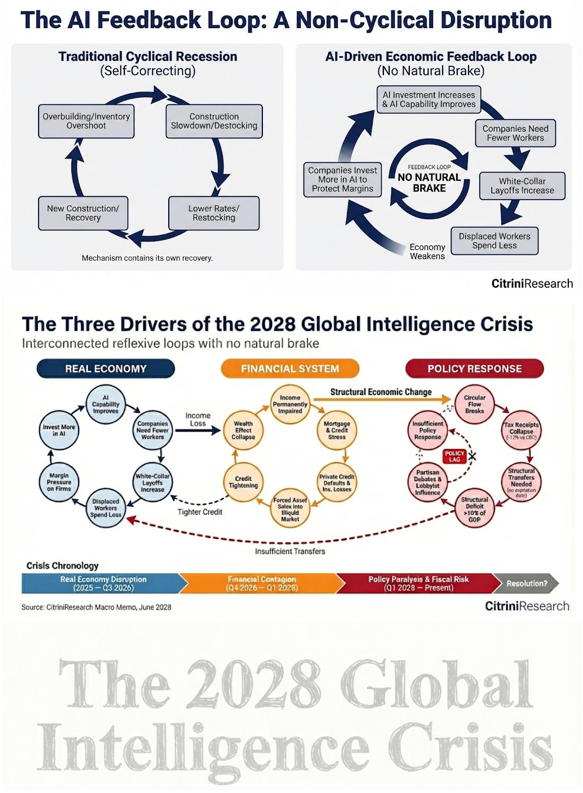
This week, Citrini Research published a thought experiment titled “The 2028 Global Intelligence Crisis,” which contributed to a nearly 2% sell-off across global equity markets. The Citrini report that set everyone off wasn’t really a forecast, it’s a well-crafted worst-case thought experiment written from the perspective of 2028 looking back at how AI supposedly triggered a white-collar recession domino effect.
It stacks every possible negative outcome: large-scale displacement of white-collar professionals, high-income households cracking, mortgages souring, credit markets seizing, financial stocks rolling over, a staircase down into economic hell. What made it powerful (and unsettling) is that it wasn’t written by a cartoon permabear; it was thoughtful, detailed, and emotionally grounded in the very real fear that good, high-paying white-collar jobs could shrink faster than society can adapt. The human element hit hardest – the idea that people in our own communities could see incomes collapse and lifestyles unravel.
Structurally, the piece relies on a rhetorical stacking of negatives with no offsets, no productivity gains, no new industries, no policy response – just cascading damage. Markets reacted sharply (financials notably), which speaks to how fragile sentiment already is around AI disruption. The bigger debate isn’t whether AI will cause displacement – it will – but whether it happens as an overnight shock that blows up credit and society, or as a gradual shift where industries shrink, adapt, and redeploy labour over time. The fear is real. The inevitability of total collapse is far less so. History suggests that in periods of profound technological change, markets often overshoot in both directions. Overreaction is part of the process, not proof that the darkest outcome is inevitable.
Related Posts



Disclaimer
Any reference to regions/ countries/ sectors/ stocks/ securities is for illustrative purposes only and not a recommendation to buy or sell any financial instruments or adopt a specific investment strategy. The views and opinions contained herein are those of the individuals to whom they are attributed and may not necessarily represent views expressed or reflected in other Southern Rock Capital Limited communications, strategies or funds. The information and opinions contained in this document are provided in good faith and are based on sources believed to be reliable. However, Southern Rock Capital Limited does not provide any guarantee regarding the accuracy or completeness of the information or opinions expressed herein. Southern Rock Capital Limited will not be held liable for any claims, damages, losses, or expenses incurred directly or indirectly by investors or their financial advisors as a result of reliance on the information contained in this document. It is important to note that Southern Rock Capital Limited does not serve as the investor's financial advisor and has not conducted a financial needs analysis. Therefore, investors and financial advisors should carefully evaluate whether the information provided in this document is appropriate for the investor's objectives, financial situation, and specific needs. Any guidance offered may have limitations in terms of suitability. Investors should be aware that no assurances of investment performance or capital protection can be inferred from the information provided in this document. It is advisable for investors to exercise caution and conduct their own research before making any investment decisions.
Southern Rock Capital Limited is authorised and regulated by the Mauritius Financial Services Commission.
