
Anthropic IPO

One of the most anticipated IPOs ever
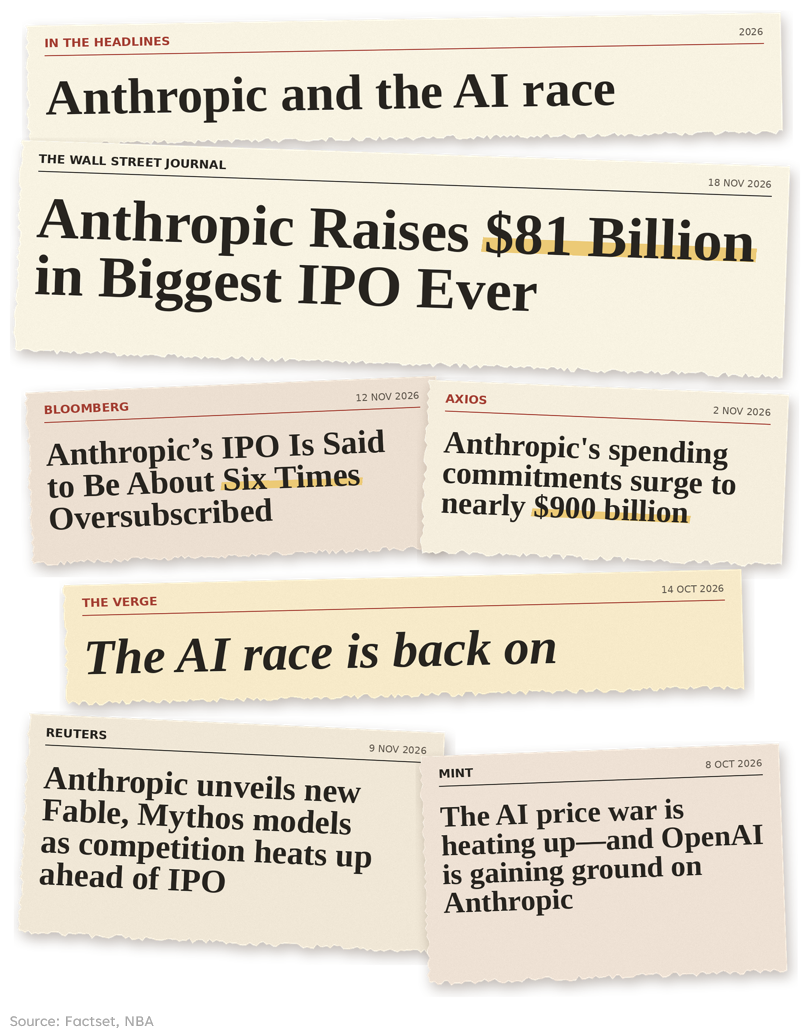
Anthropic is listing after a bruising sell-off in chipmakers and cloud companies, growing doubts about the money going into data centres, and the sudden departure of Nvidia CEO Jensen Huang, the most recognisable face of the AI boom. By the time Anthropic priced its shares, the Nasdaq 100 was about 13% below its early October peak. Even so, investors lined up for an $81.3 billion offering, the biggest IPO on record.
So what’s all the fuss about? Much of the AI boom has centred on the companies selling chips and renting out computing power. Anthropic sells Claude, which businesses use to write code, review documents and get work done. The listing gives investors a direct stake in one of the leading AI labs and brings them closer to the question that matters for the whole industry. Once the data centres are built, how much will customers pay for what AI can do?
A strong debut that holds up could restore some confidence across AI stocks. If the shares struggle despite all that demand, investors may rethink what they’re willing to pay for the rest of the sector. The IPO attracted plenty of buyers at $83 a share, but whether that enthusiasm holds once trading begins remains to be seen.
The most encouraging number in the filing
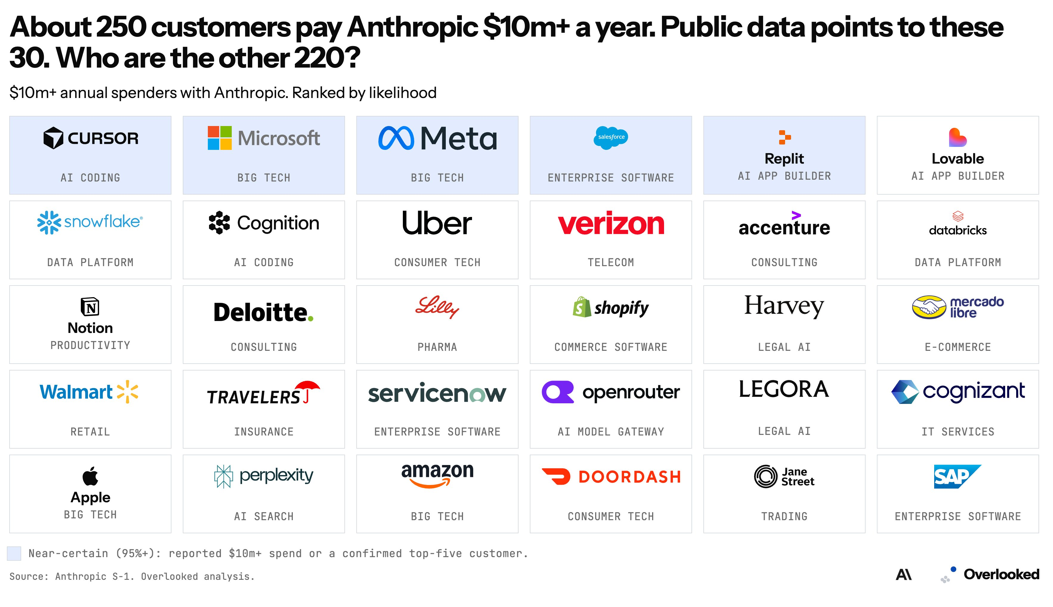
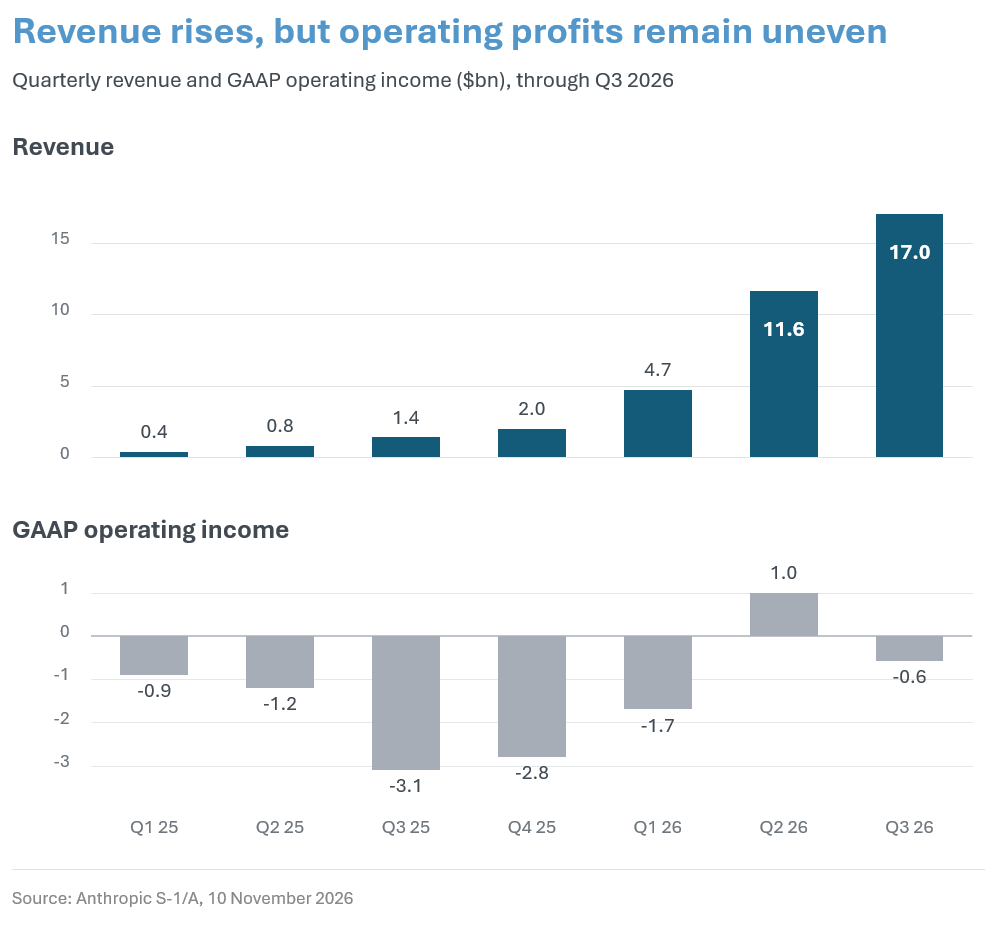
Anthropic’s revenue rose from $2.5 billion in the first nine months of 2025 to $33.2 billion in the corresponding period of 2026. The more interesting number is 79%. That was the share of September-quarter sales that came from outside its five biggest customers, up from 64% in the March quarter. Each of those five customers still spent a record amount with Anthropic in the September quarter. The rest of the business simply grew faster. Over the first nine months, no single customer accounted for more than 10% of sales.
More than 11,900 customers paid Anthropic at least $100,000 in the year to September, up from just over 950 a year earlier. More than half of the Fortune 500 crossed that threshold. And the uses are broadening. Intuit uses Claude to explain tax rules, Harvey builds it into tools for lawyers, and Grab uses it to support merchants across Southeast Asia. Among those Fortune 500 customers, Anthropic still accounted for less than 0.1% of their total expenses on average in the September quarter. There’s room to grow even within companies already on the customer list.
The biggest IPO ever
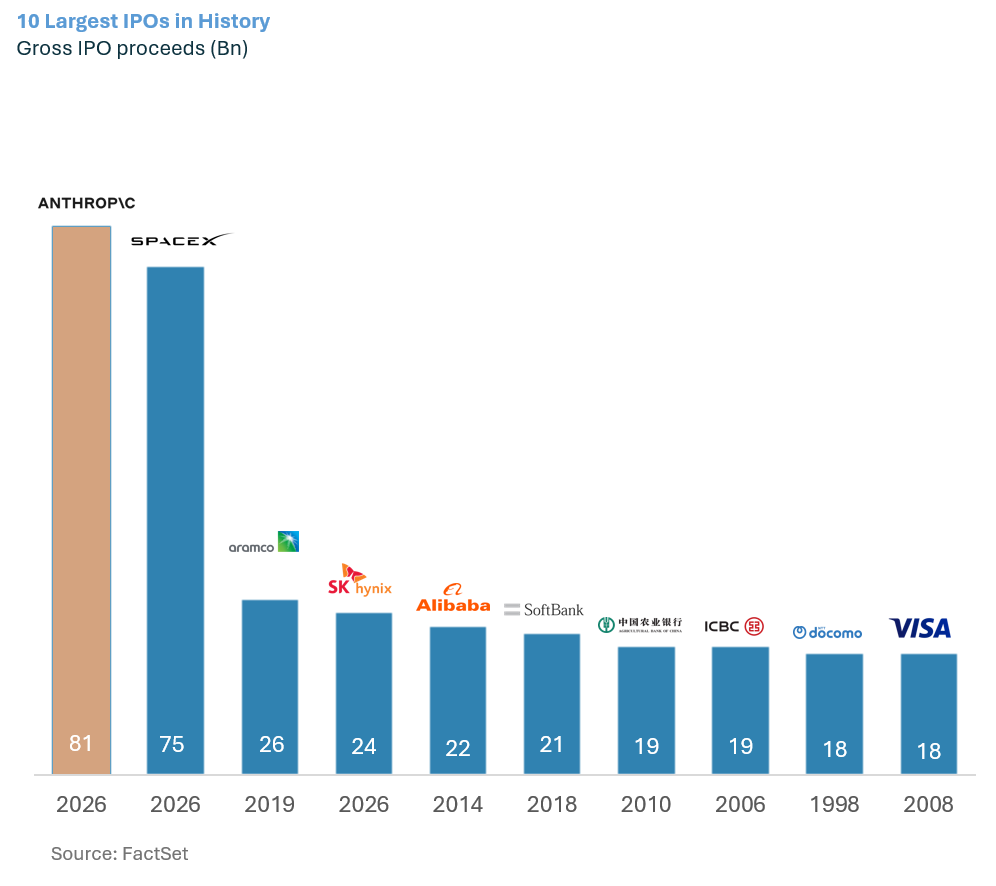
Anthropic priced at $83 a share, above its original $70 – $78 range, and increased the number of shares on offer from 825 million to 980 million. Bloomberg reported that ahead of pricing, investors had requested nearly seven times the shares then available. The public offering came to $81.3 billion, ahead of the $75 billion SpaceX initially sold in June. A separate $26 billion investment by a group of private buyers brought the combined total to $107.3 billion.
SpaceX’s public offering eventually reached $86.25 billion before fees after its banks sold additional shares. Anthropic could raise as much as $93.5 billion if its banks exercise the full option to sell extra shares. For now, Anthropic holds the record for the largest initial offering, although the final total remains uncertain. Given how heavily the IPO was oversubscribed, demand from investors is clearly not an issue.
When suppliers become shareholders
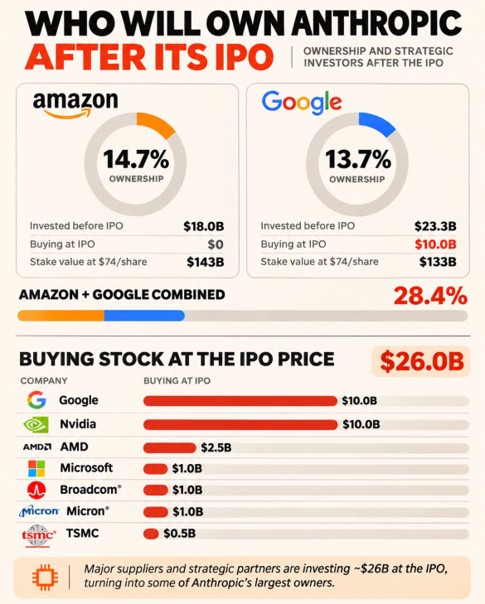
Alongside its IPO, Anthropic lined up $26 billion from seven technology companies at the same $83 share price. Google and Nvidia are putting in $10 billion each, AMD $2.5 billion, Microsoft, Broadcom and Micron $1 billion each, and TSMC $500 million. The preliminary prospectus put Amazon and Google’s combined ownership at roughly 28% after the offering.
Google is the clearest example of how those relationships work. It’s investing $10 billion as part of an existing funding commitment, while Anthropic has agreed to spend at least $121 billion on Google’s cloud services through July 2033, even if it uses less computing power than it booked. If Claude takes off, Google can benefit twice, through the services it sells and the shares it owns.
That adds another dimension to the $900 billion question. A supplier can grow its sales as Anthropic builds out, even while Anthropic is still working out how to make that spending pay. If demand falls short, the same suppliers could face weaker sales growth and a smaller return on their stakes. What matters now is whether Anthropic can turn its growing computing capacity into enough customer revenue to justify the cost.
The less glamorous number is $900 billion
Anthropic’s operating loss narrowed from $5.2 billion to $1.3 billion in the first nine months, even as its bill for computing power and infrastructure climbed to $18.8 billion. Its filing also disclosed about $901 billion in spending commitments over time, almost all tied to computing power and infrastructure. Some of those contracts require Anthropic to pay for capacity even if it goes unused. How much will customers pay for Claude if rival tools become good enough for the same work, while Anthropic is still paying for the capacity it booked years earlier?
*Of the $900.9bn disclosed, $186.2bn is subject to termination rights or conditions. A further estimated $150bn–$175bn under variable arrangements is excluded.
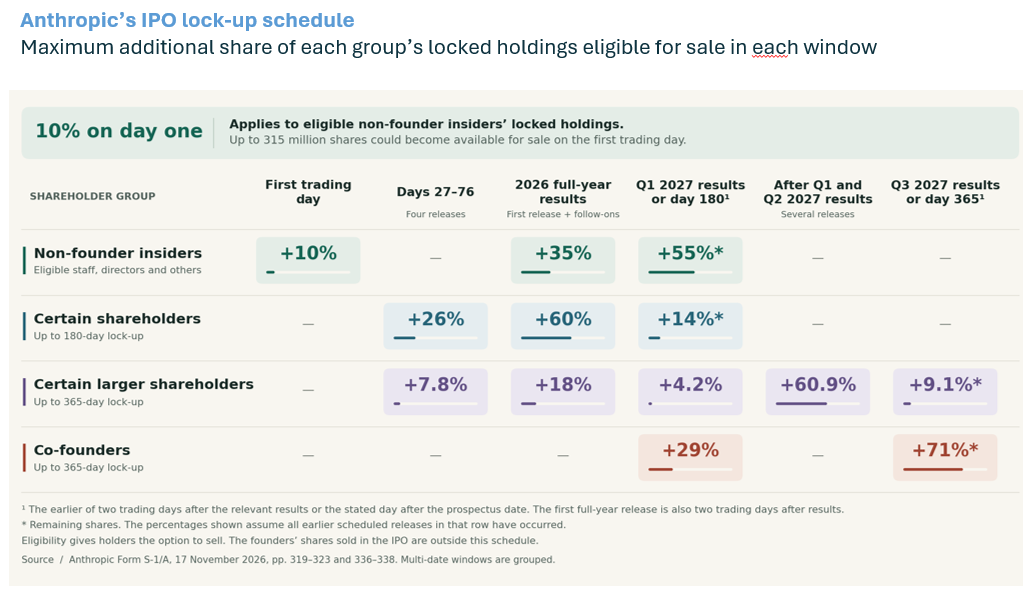
The selling window lasts a year.
From the first day of trading, certain Anthropic employees, former employees, consultants, directors and executives outside the founding team can sell up to 10% of their own locked-up holdings. Anthropic’s 17 November filing put that at up to 315 million shares, roughly a third of the 980 million shares sold in the IPO. That’s how many could become available on day one, and actual selling will depend on what those holders choose to do.
Anthropic’s schedule has 23 release points, several tied to when the company reports results. The first big one comes two trading days after its 2026 full-year results, when up to 1.7 billion more shares could become eligible for sale. The founders are on a different timetable. Apart from shares they sold in the IPO itself, they can sell up to 29% of their locked-up holdings after the first-quarter 2027 results or at the 180-day mark, whichever comes first. The remaining restrictions expire after the third-quarter results or at the one-year mark, whichever comes first.
That makes Anthropic’s first full-year results a date worth circling. Investors will find out how quickly Claude is growing at almost the same time as a large group of existing shareholders gets the chance to cash in. How much of the demand we saw at the IPO will still be there when buyers have more shares to choose from?
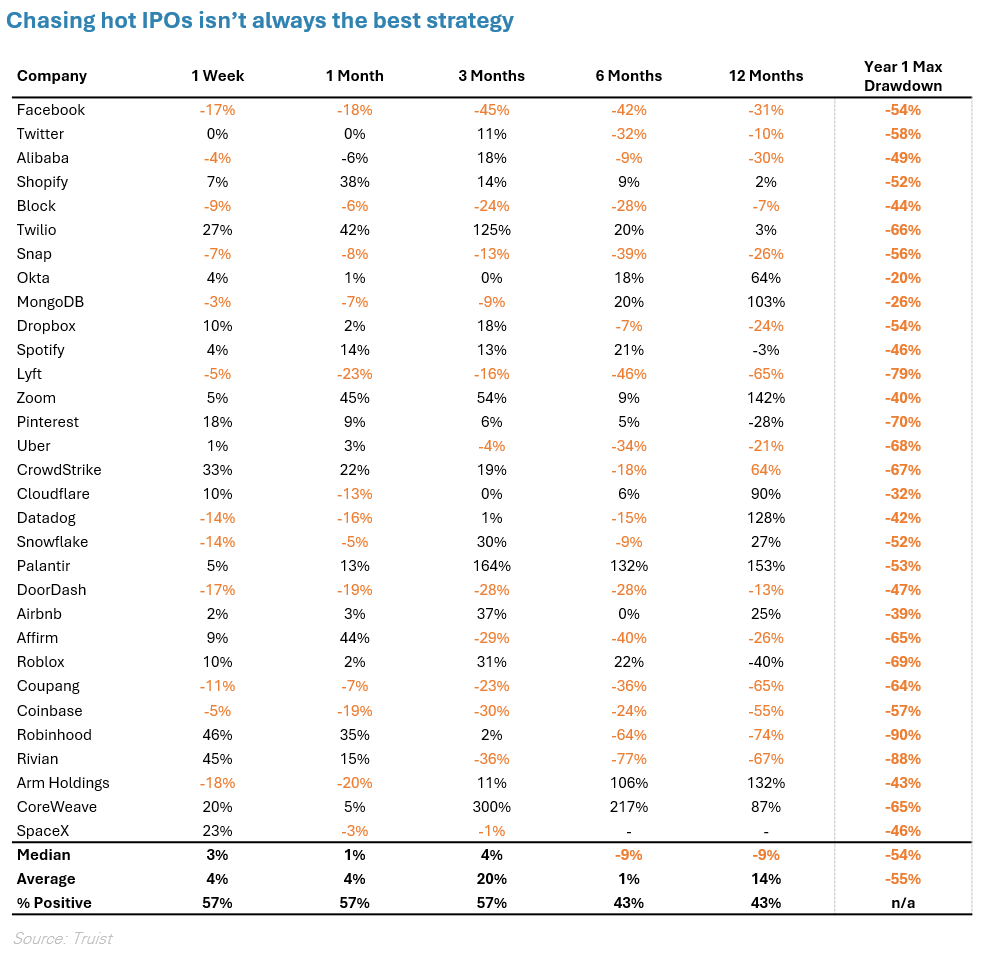
SpaceX offers a lesson about the price you actually pay.
We’ve updated the table from our original SpaceX IPO note to show what happened after the listing. SpaceX gained 23% in its first week, but by the three-month mark it was 1% below its starting price. Across the listings with a full year of data, only 43% were ahead after 12 months, and the typical stock fell 54% from a peak at some point in its first year. Some of these companies went on to reward investors handsomely. As Anthropic lists, the table is a reminder that even when the business story is compelling, the price you pay on day one can leave you with a long wait.
That’s the distinction worth keeping in mind as Anthropic starts trading. The $83 offer price tells us what investors with an IPO allocation paid. Everyone buying on the market faces a price of their own. The question for them is how much of Claude’s future success that price already assumes.
Related Posts


Disclaimer
Any reference to regions/ countries/ sectors/ stocks/ securities is for illustrative purposes only and not a recommendation to buy or sell any financial instruments or adopt a specific investment strategy. The views and opinions contained herein are those of the individuals to whom they are attributed and may not necessarily represent views expressed or reflected in other Southern Rock Capital Limited communications, strategies or funds. The information and opinions contained in this document are provided in good faith and are based on sources believed to be reliable. However, Southern Rock Capital Limited does not provide any guarantee regarding the accuracy or completeness of the information or opinions expressed herein. Southern Rock Capital Limited will not be held liable for any claims, damages, losses, or expenses incurred directly or indirectly by investors or their financial advisors as a result of reliance on the information contained in this document. It is important to note that Southern Rock Capital Limited does not serve as the investor's financial advisor and has not conducted a financial needs analysis. Therefore, investors and financial advisors should carefully evaluate whether the information provided in this document is appropriate for the investor's objectives, financial situation, and specific needs. Any guidance offered may have limitations in terms of suitability. Investors should be aware that no assurances of investment performance or capital protection can be inferred from the information provided in this document. It is advisable for investors to exercise caution and conduct their own research before making any investment decisions.
Southern Rock Capital Limited is authorised and regulated by the Mauritius Financial Services Commission.
