
SpaceX IPO

SpaceX
This is no longer a rocket company
When most people hear the name SpaceX, they think of rockets launching into space. But for many investors, the moment that truly captured the imagination was watching a giant Starship booster descend from the edge of space and be caught mid-air by enormous mechanical arms attached to the launch tower. It was one of those rare moments that seemed to blur the line between science fiction and reality.
Arthur C. Clarke famously wrote that “any sufficiently advanced technology is indistinguishable from magic,” and watching a skyscraper-sized rocket return to Earth and land in the arms of a tower felt remarkably close to that idea.
Today, SpaceX is far more than a rocket company. It sits at the centre of some of the world’s most important technological trends, from satellite internet and communications infrastructure to artificial intelligence and national security. Investors buying SpaceX are not simply buying a space company; they are buying a stake in a business that is trying to build the infrastructure of the future.

The IPO the Market Had Been Waiting For
For years, SpaceX was one of the most sought-after private companies in the world. Investors watched from the sidelines as private funding rounds pushed valuations higher and higher, while ordinary investors had virtually no way to gain direct exposure. That changed with the company’s public listing, which quickly became one of the largest and most anticipated IPOs in market history. The enthusiasm was extraordinary.
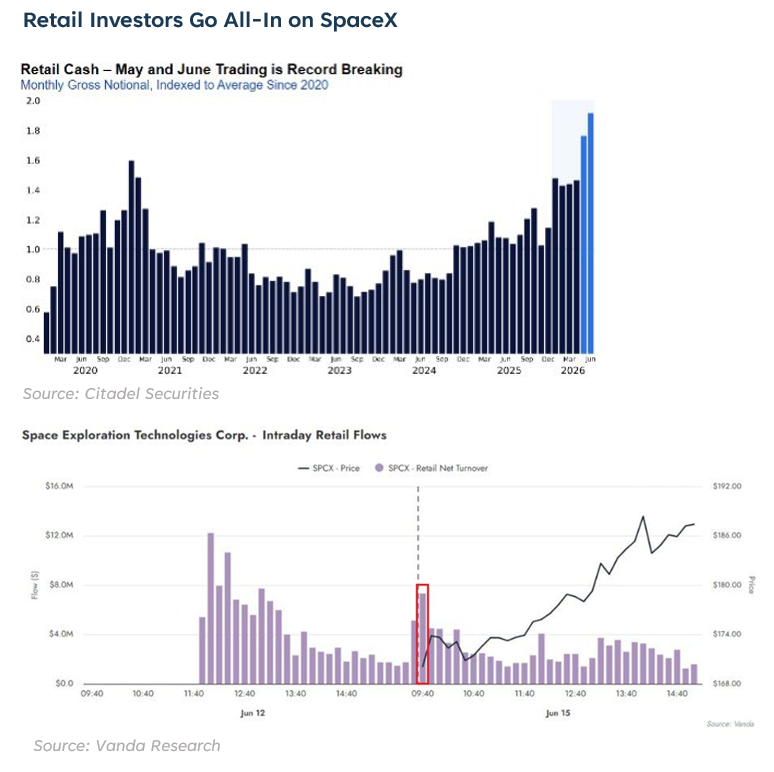
According to Vanda Research, retail investors bought nearly as much SpaceX stock in the first two trading sessions as they had bought in all other individual U.S. stocks combined during the entire previous week.
Citadel Securities, which handles roughly 35% of U.S. retail trading volume, said the day of the IPO was the largest single day of net retail stock buying it had ever recorded. The listing was less the birth of a public company and more a rare market event that investors felt they simply had to be part of.
Day One: The Market Sends a Message
The first day of trading told investors everything they needed to know about demand. Shares opened strongly above the IPO price as buyers rushed to gain exposure to a company that many had waited years to own. Trading volumes surged, media coverage dominated financial headlines and market participants debated whether this was the beginning of a new era for the company or simply another example of IPO enthusiasm.
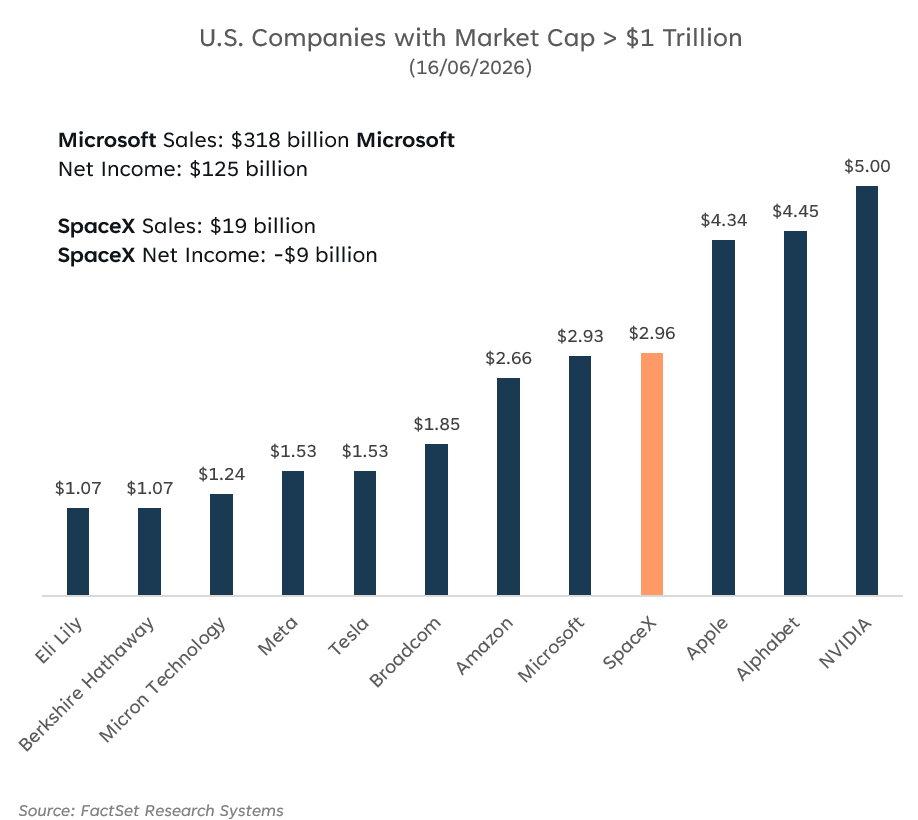
What became immediately clear was that investors were willing to pay a premium for access. Within hours, the market had added hundreds of billions of dollars to the company’s value. While valuation discussions will continue for years, the message from the market was unmistakable: investors see SpaceX as one of the defining growth stories of the coming decade.
Understanding the Elon Effect
It is impossible to discuss SpaceX without discussing Elon Musk. Few individuals have had a greater impact on modern capital markets. Whether through Tesla, SpaceX or his other ventures, Musk has developed an ability to attract investor attention that is almost unprecedented.
This phenomenon, often referred to as the “Elon Effect”, can be both a blessing and a risk. On the positive side, his reputation for innovation attracts capital, talent and media attention. Investors are often willing to look beyond short-term challenges because they believe in his ability to execute on ambitious long-term visions.
However, the same dynamic can create heightened volatility. Sentiment can swing rapidly, and stock prices can sometimes become disconnected from traditional valuation measures.
For investors, buying SpaceX is therefore not only a judgement on rockets, satellites or internet services. It is also a judgement on one of the most influential entrepreneurs of our generation.

The Governance Story Hidden in the Fine Print
One of the most interesting aspects of the IPO has received far less attention than the share price. Buried within the company’s constitutional documents is a governance structure that ensures control remains firmly in the hands of insiders.
While public investors can purchase shares and participate in the company’s economic success, their influence over major corporate decisions is limited. Through a multi-class share structure, certain shareholders retain significantly greater voting power than ordinary investors. This means that even as the company becomes publicly traded, strategic direction and control remain concentrated among a relatively small group of insiders.
This structure is not unique. Similar arrangements exist at companies such as Alphabet and Meta. However, it serves as an important reminder that ownership and control are not always the same thing. Investors may own part of the business, but they should not assume they have a meaningful say in how it is run.

The Index Inclusion Story Nobody Is Talking About
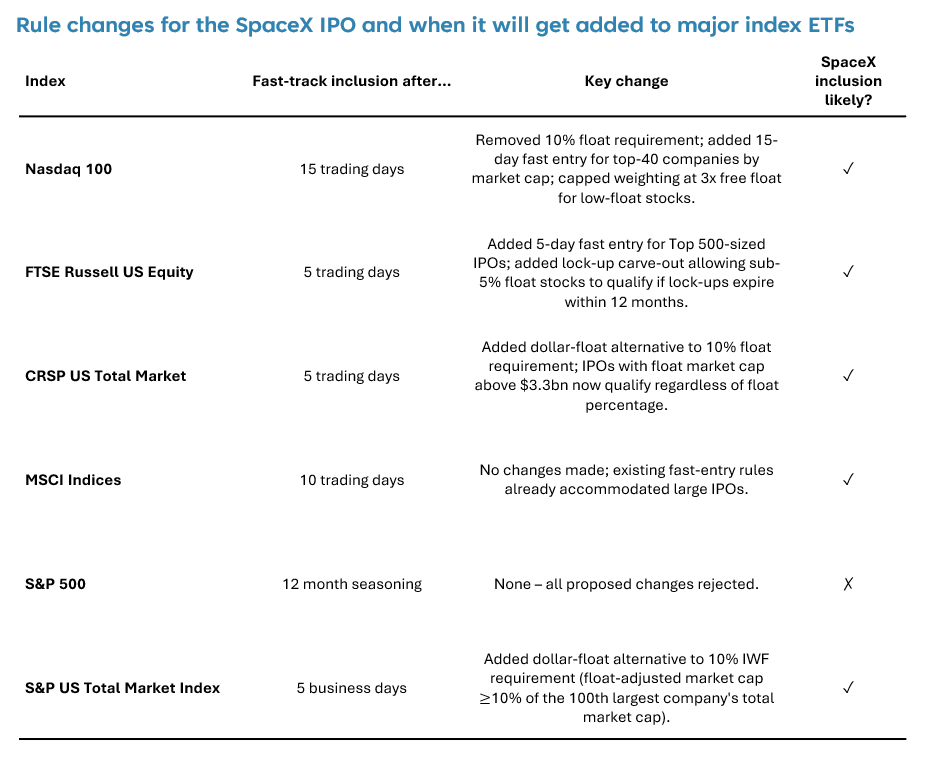
One of the most fascinating consequences of the listing may have nothing to do with SpaceX itself and everything to do with how modern markets work. Over the past two decades, passive investing has become one of the dominant forces in global markets. Trillions of dollars now sit in index funds that simply buy whatever is included in major benchmarks. As a result, when a company as large as SpaceX becomes eligible for inclusion in major indices, it can trigger enormous automatic buying.
Nasdaq, MSCI and FTSE Russell all have mechanisms that may allow a company of SpaceX’s size to enter their benchmarks relatively quickly. If that happens, passive funds tracking those indices will be required to purchase shares regardless of valuation. The result could be billions of dollars of additional demand arriving in the market simply because the rules say it must.
Ironically, some of the biggest buyers of SpaceX stock in the coming months may not be active investors at all.
The Scarcity Factor
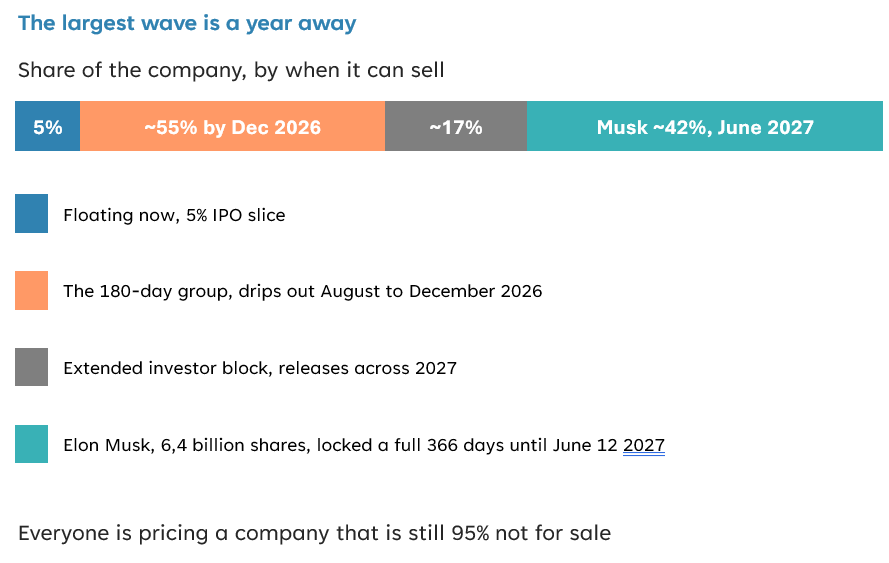
Another interesting feature of the listing is the relatively limited number of shares available for public trading. Although the company is enormously valuable, only a fraction of the total shares are freely tradable. Most remain in the hands of founders, early investors and insiders.
This matters because supply and demand still drive markets. When investor demand is extremely high but the available supply of shares is limited, prices can move sharply. The scarcity of freely traded shares has historically contributed to volatility in several high-profile technology listings, and SpaceX may prove no different.
Investors should therefore pay close attention to future lock-up expiries. As additional shares become eligible for sale, market dynamics can change significantly. Some of the biggest tests for the stock may come months after the IPO rather than on listing day itself.
Why SpaceX Matters Beyond Space
Perhaps the most important question is not whether SpaceX will succeed as a public company, but what its listing tells us about the future of markets. SpaceX represents a new generation of companies that have remained private far longer than businesses traditionally did. By the time it reached public markets, it was already larger than many established global corporations, forcing index providers, fund managers and regulators to rethink how they deal with companies of unprecedented scale.
Yet describing SpaceX simply as a space company no longer captures its significance. It is a technology company, an infrastructure company, a communications company and, increasingly, a market phenomenon. The listing combines many of the defining themes of modern investing: founder-led businesses, passive investing, retail participation, concentrated governance and enormous expectations for future growth. In many respects, SpaceX may become the blueprint for future listings, with lessons from this IPO likely to influence how markets eventually handle other highly anticipated private companies.
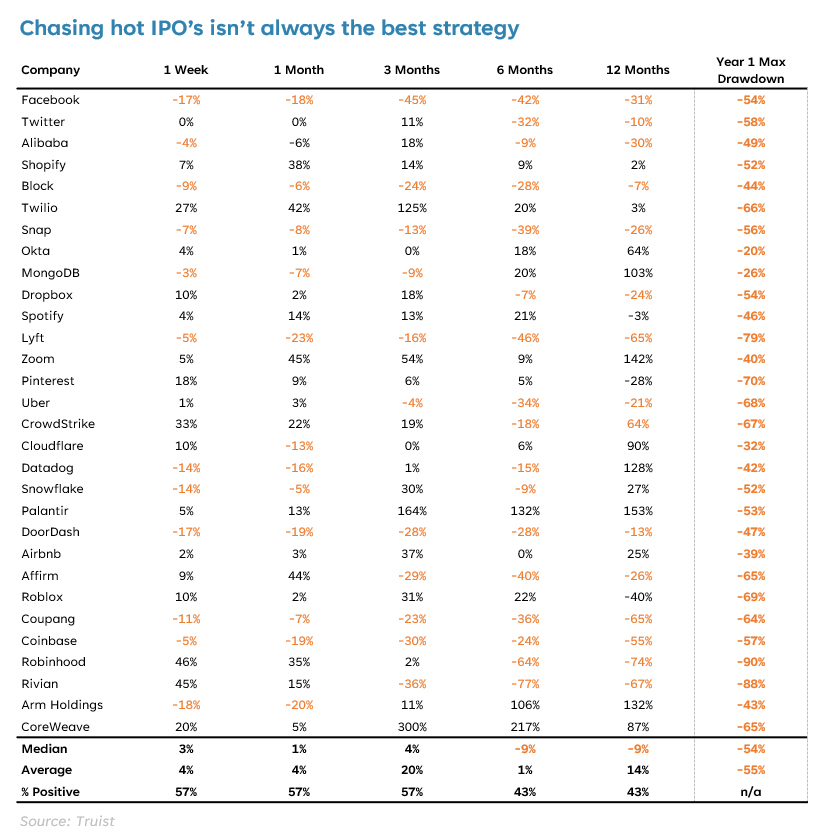
Whether the shares ultimately prove cheap or expensive will only be known with the benefit of hindsight. Based on research from Truist, however, chasing hot IPOs, even those with compelling growth stories, has historically led to severe drawdowns, with the average stock falling more than 50% from its post-listing peak. What is already clear, however, is that SpaceX has become much more than just another IPO. It has become one of the defining market events of the decade.
Related Posts



Disclaimer
Any reference to regions/ countries/ sectors/ stocks/ securities is for illustrative purposes only and not a recommendation to buy or sell any financial instruments or adopt a specific investment strategy. The views and opinions contained herein are those of the individuals to whom they are attributed and may not necessarily represent views expressed or reflected in other Southern Rock Capital Limited communications, strategies or funds. The information and opinions contained in this document are provided in good faith and are based on sources believed to be reliable. However, Southern Rock Capital Limited does not provide any guarantee regarding the accuracy or completeness of the information or opinions expressed herein. Southern Rock Capital Limited will not be held liable for any claims, damages, losses, or expenses incurred directly or indirectly by investors or their financial advisors as a result of reliance on the information contained in this document. It is important to note that Southern Rock Capital Limited does not serve as the investor's financial advisor and has not conducted a financial needs analysis. Therefore, investors and financial advisors should carefully evaluate whether the information provided in this document is appropriate for the investor's objectives, financial situation, and specific needs. Any guidance offered may have limitations in terms of suitability. Investors should be aware that no assurances of investment performance or capital protection can be inferred from the information provided in this document. It is advisable for investors to exercise caution and conduct their own research before making any investment decisions.
Southern Rock Capital Limited is authorised and regulated by the Mauritius Financial Services Commission.
